
 by
by 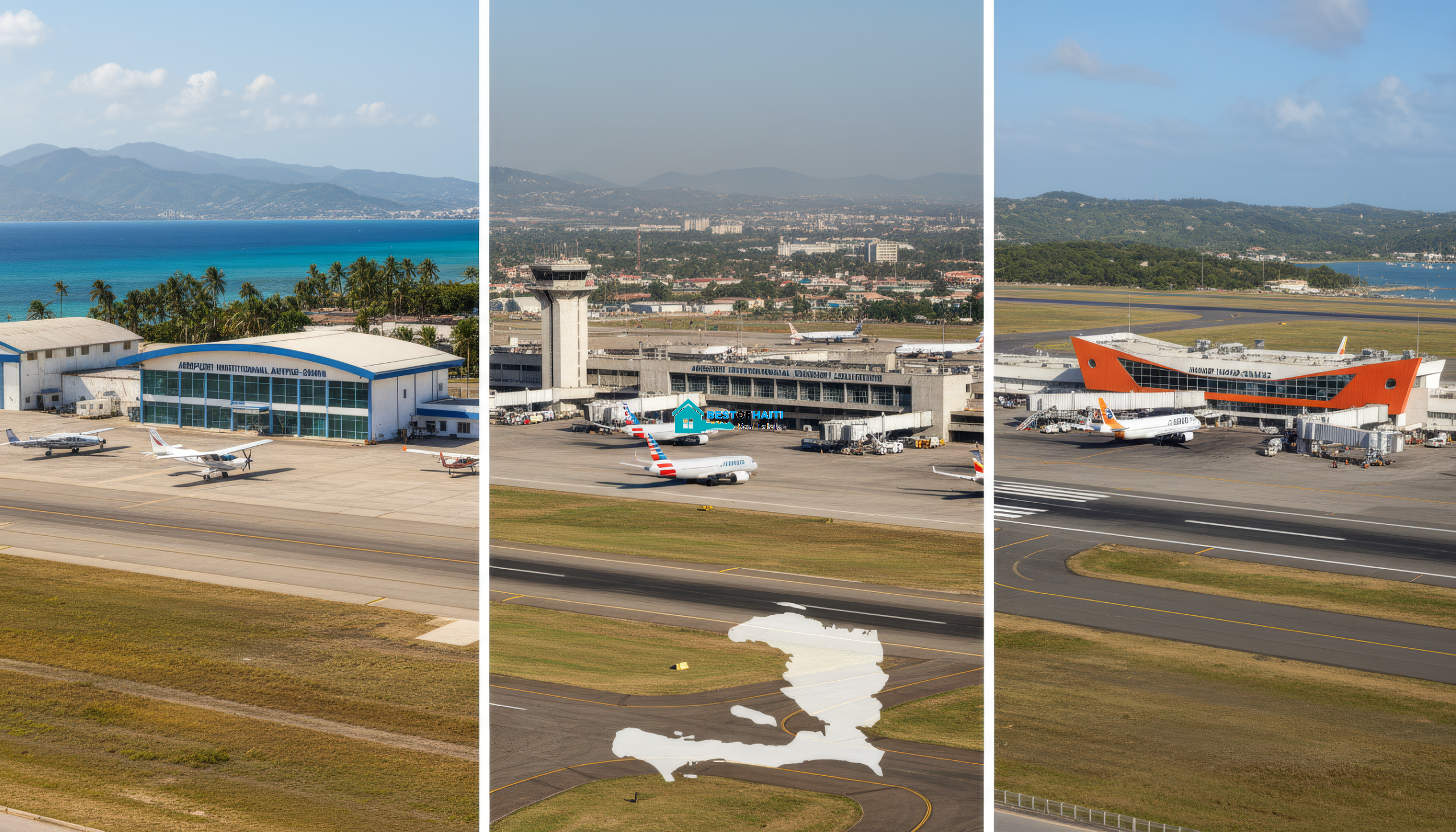
Comparing Haiti’s three international airports. For most of its modern history, Haiti had only one airport with international importance: Toussaint Louverture International Airport in Port-au-Prince. Other airports had mostly domestic uses. However, things have changed now. Gang control in the capital has pushed international flights to the country’s northern and southern sides. This has made Cap-Haïtien and Les Cayes airports the country’s gateway from an external perspective. Below is the story behind how three different airports came into being to connect Haiti with the outside world.
Toussaint Louverture International Airport (PAP), Port-au-Prince
First and foremost, Toussaint Louverture International Airport, also known as “Maïs-Gâté Airport” because of its location in the area called Cul-de-Sac Plain. It is the country’s first and main airport. Commissioned in 1965 as François Duvalier International Airport and built with U.S. and Haitian government grants, the airport later took the name of the Haitian Revolution’s leader. Its runway is 3,040 meters long, and it usually serves about 1.9 million passengers annually, significantly outclassing all other airports in Haiti in capacity.
Currently, PAP is considered the most problematic one of all. Following attacks on Haitian state infrastructure carried out by armed gangs, Viv Ansanm, gangs have gained control of about 90% of the territory in Port-au-Prince, including the way to the airport and neighboring neighborhoods. The airport had to be closed for three months after the attacks, and gunmen shot down several planes, including the plane of Spirit Airlines, which was hit by fire while landing, and its attendant was injured; other planes on the ground were damaged.
The U.S. Federal Aviation Administration (FAA) banned all flights to Haiti in November 2024, as three commercial airliners flying from the U.S. had been attacked by gunmen. Later, flights were allowed to several northern and southern airports, but the ban on flights below 10,000 feet over Port-au-Prince was still enforced and regularly extended. In its latest extension of September 2, 2026, FAA decided not to lift the ban until March 2027 because of gang’s access to small arms and drones that could reach planes at low altitude.
The airport was opened physically in December, and domestic commercial flights returned by June. Currently, no commercial international airline is running flights there anymore.
RELATED: How Diaspora Investors Are Transforming Les Cayes, Haiti With Luxury Vacation Rental Properties
Cap-Haïtien International Airport (CAP), officially Hugo Chávez International Airport
Cap-Haïtien International Airport, situated along the northern shores of Haiti, ranks second in terms of traffic among the country’s airports and, since 2013, it bears a rather unique title – Hugo Chávez International Airport, after the late president of Venezuela. The title is a result of repaving of its runway, paid for by the Venezuelan government of that time as part of their efforts to help Haiti after the earthquake of 2010; the government committed more than a billion dollars to aid in the aftermath of the disaster. However, even today, the majority of the passengers and the majority of the aviation media persistently call it Cap-Haïtien.
The length of the runway reaches 2,652 meters, which allows handling of jets, and the airport itself is far from the territories controlled by the gangs in and around the capital city of Haiti. Thus, it became one of the two working airports in Haiti during this crisis. The airport is on the Federal Aviation Administration (FAA) approved list during all this time of restrictions imposed at the airport of Port-au-Prince, and it did not face the shooting incidents like those in the capital. It is operated by Sunrise Airways, which is the Haitian airline, along with several smaller charters; the big U.S. airlines avoid operating here.
Antoine-Simon International Airport (CYA), Les Cayes or OKAY
The most recently added airport in the network of Haiti’s international airports is also the smallest one. Located in to handle and operating on the southern peninsula of Haiti, Antoine-Simon Airport came into operation in 2005 and acquired its international status only in March 2026 after an extensive upgrading process that started back in 2013. The extension of the runway to 1,850 meters, the increase in the category of the airport from 2B to 3B, and the capacity for handling aircraft carrying between 50 and 80 people have all made it possible for the airport to serve regional jets and large turboprop planes, but not wide-body planes.
Despite the recent upgrading and regardless of being the fourth busiest airport in Haiti in terms of passenger traffic, after the capital and Cap-Haïtien, Les Cayes now enjoys an extremely important status as an international airport for the southern part of the country. The fact is that up to the recent upgrading, this southern region had no alternative but using the capital for any international connection. The airline company IBC Airways has already started direct flights between Miami and Les Cayes and the airline Sunrise Airways has joined this airport’s network of operations. The airport is viewed as the start of an extensive process aimed at decentralizing Haiti’s economy from Port-au-Prince.
Comparing Haiti’s Three International Airports: DATA CHARTS
| Toussaint Louverture (PAP) | Cap-Haïtien / Hugo Chávez (CAP) | Antoine-Simon (CYA) | |
|---|---|---|---|
| City served | Port-au-Prince | Cap-Haïtien | Les Cayes |
| IATA / ICAO | PAP / MTPP | CAP / MTCH | CYA / MTCA |
| Runway length | 3,040 m (9,974 ft) | 2,652 m (8,701 ft) | 1,850–1,910 m (6,070–6,266 ft) |
| Elevation | 98 ft (30 m) | 10 ft (3 m) | 230 ft (70 m) |
| Rank by passenger traffic | 1st (largest) | 2nd | 4th |
| Passenger volume (last stable year, 2017) | ~1,893,470 | Second-highest nationally (figure not published) | Fourth-highest nationally |
| Gained international status | Long-established (1965) | Long-established | March 5, 2026 (upgraded) |
| Current international commercial service | None — military/diplomatic/humanitarian only | Active | Active |
| Notable current carriers | — (commercial suspended) | Sunrise Airways and smaller charters | IBC Airways (Miami), Sunrise Airways |
| FAA status (as of Sept 2026) | Banned below 10,000 ft through ~March 2027 | Approved | Approved |
Comparing Haiti’s Three International Airports: What this Reshuffling says about the country
Normally, the size and capabilities of an airport dictate the amount of traffic it carries. In the case of Haiti, the current situation has reversed this principle. Toussaint Louverture International Airport is still, in theory, Haiti’s best airport, being the longest one, carrying the largest number of passengers historically, and having the largest number of facilities. But it is the control of the gangs over the area surrounding the capital that determines the Haitian airport, which serves as a connection between the country and the rest of the world. Cap-Haïtien and Les Cayes, being smaller and less equipped, are working gateways only due to the fact that they are located outside of the gang-controlled areas.
The new reality is likely to continue until the situation in Port-au-Prince stabilizes. Each new Port-au-Prince restriction of the Federal Aviation Administration has been issued every six months since November 2024 due to the same problem, namely the inability of the Haitian security forces to secure the airspace over the capital. Until the problem is solved, the aviation map of Haiti will be following the current principle, meaning that Haiti will not have its largest airport as the center, but the airports in the northern and southern parts of the country. To listen to “Comparing Haiti’s Three International Airports,” please visit our YouTube channel here for more details.


Join The Discussion